
A good third of industrial process heat is needed below 200 °C (Agora Industry 2022). For this temperature band, mature electric solutions exist today. Whether they pay off is rarely decided by the equipment itself. It is decided by three questions: which temperature does each consumer really need, which heat is already available on site, and in which hours is the power bought?
Why the gas boiler so often stays
A boiler delivers one temperature to every consumer, around the clock, at a predictable price. A steam network serves processes that need 70 °C just as it serves those at 180 °C. Replacing the boiler therefore means replacing a whole supply logic, not a single unit.
Per kilowatt-hour, electricity is markedly dearer than natural gas. Electrification that copies the boiler one to one is therefore usually more expensive. Electrification that reorganises the heat system often is not.
Three insights from our transformation plans
Insight 1
Temperature belongs to the consumer, not the site
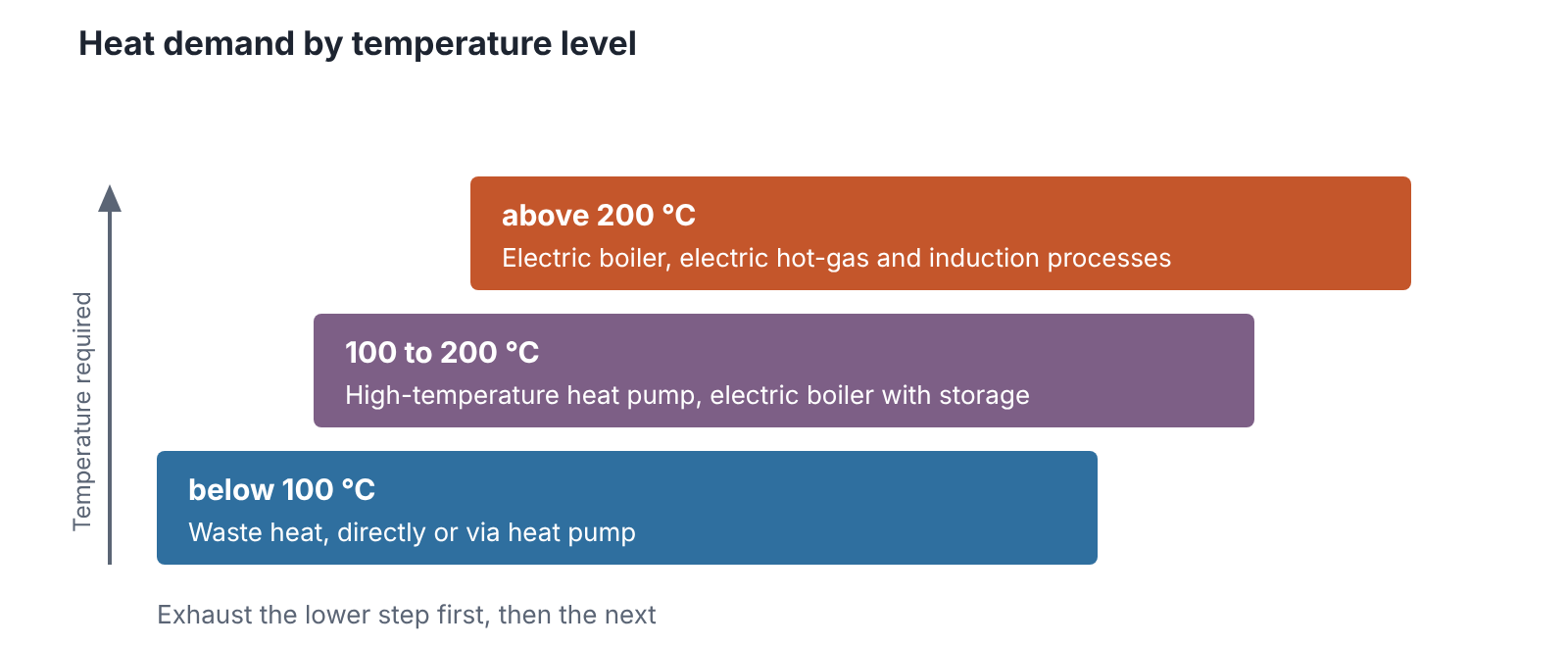
Sort the heat consumers by what they actually need and a pattern appears again and again: a large share of the steam only heats water below 100 °C. That share can be covered more cheaply with waste heat and heat pumps.
Insight 2
Waste heat first, because it is price-robust
Heat from refrigeration, compressed air, wastewater or condensate has already been paid for. Measures that use it stay economic in almost every power price scenario and often carry most of the first reduction stage in our plans.
Insight 3
Electrification is decided in power procurement
For the remaining high-temperature demand, the business case depends on power price, grid fees and connection capacity. Storage and the supply contract are therefore part of the technical solution, not an afterthought.
The tools
Heat pump
Lifts existing waste heat to useful temperature. Up to about 100 °C it is state of the art, up to around 200 °C increasingly available. The smaller the temperature lift, the more efficient it runs (UBA 2023).
Power to heat with storage
Electric boilers turn power into hot water or steam with hardly any losses. Thermal storage decouples power purchase from heat demand, so the timing of the purchase becomes the economic lever.
Electric high-temperature heat
Above 200 °C, electric hot-gas and induction processes replace the burner. What matters is keeping the heat inside the process instead of losing it through the stack.
A staged path instead of one big decision
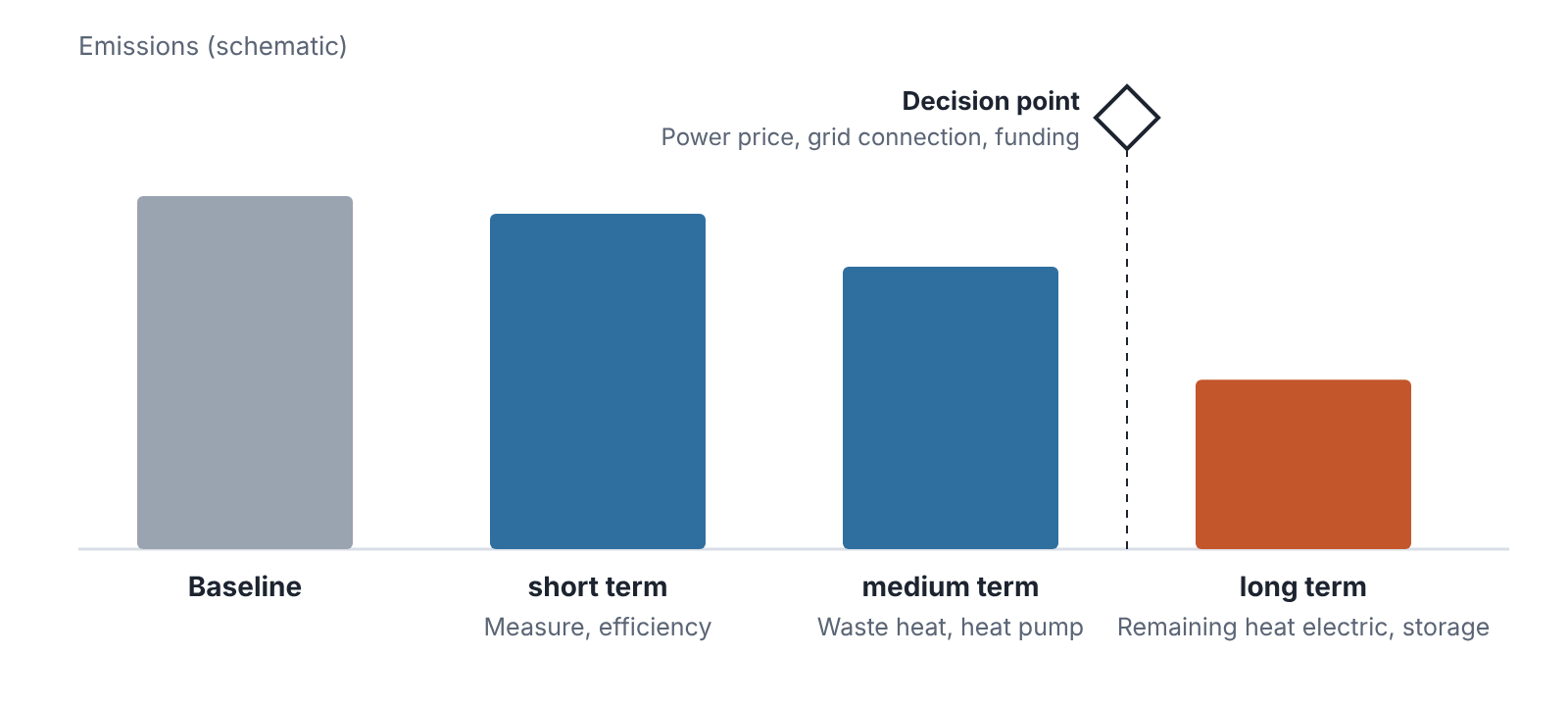
No site converts its heat supply in a single step. What works is a path that starts with low-risk measures and ties the large investments to clearly named decision points.
How we work
- Measure: load profiles, temperatures and waste heat streams over a representative period.
- Sort: all heat consumers by temperature and operating hours, all sources by availability.
- Calculate: options independent of any manufacturer, with every assumption stated and several power price scenarios.
- Decide: a path of measures with decision points and the matching funding programmes.
Where does your site stand?
A transformation plan starts with measurement and an honest inventory, not with a technology decision. Get in touch if you want your heat demand assessed.
Sources: Agora Industry (2022), “Power-2-Heat – Gas savings and climate protection in industry”: a good third of industrial process heat demand is below 200 °C. IEA Heat Pumping Technologies, Annex 58: around 37 % of European industrial process heat demand is below 200 °C. German Environment Agency (UBA), Texte 161/2023 “CO2-neutral process heat generation”: coefficient of performance of high-temperature heat pumps depends on the temperature lift.